
Stories
The first swim: the ten minutes that shape a lifetime of water
A shallow cove on a warm August evening, and a puppy standing at the edge of the only thing he was really built for. Retrievers are not born knowing how to swim — they are born wanting to, which is not the same thing. Here is how to get the first one right.
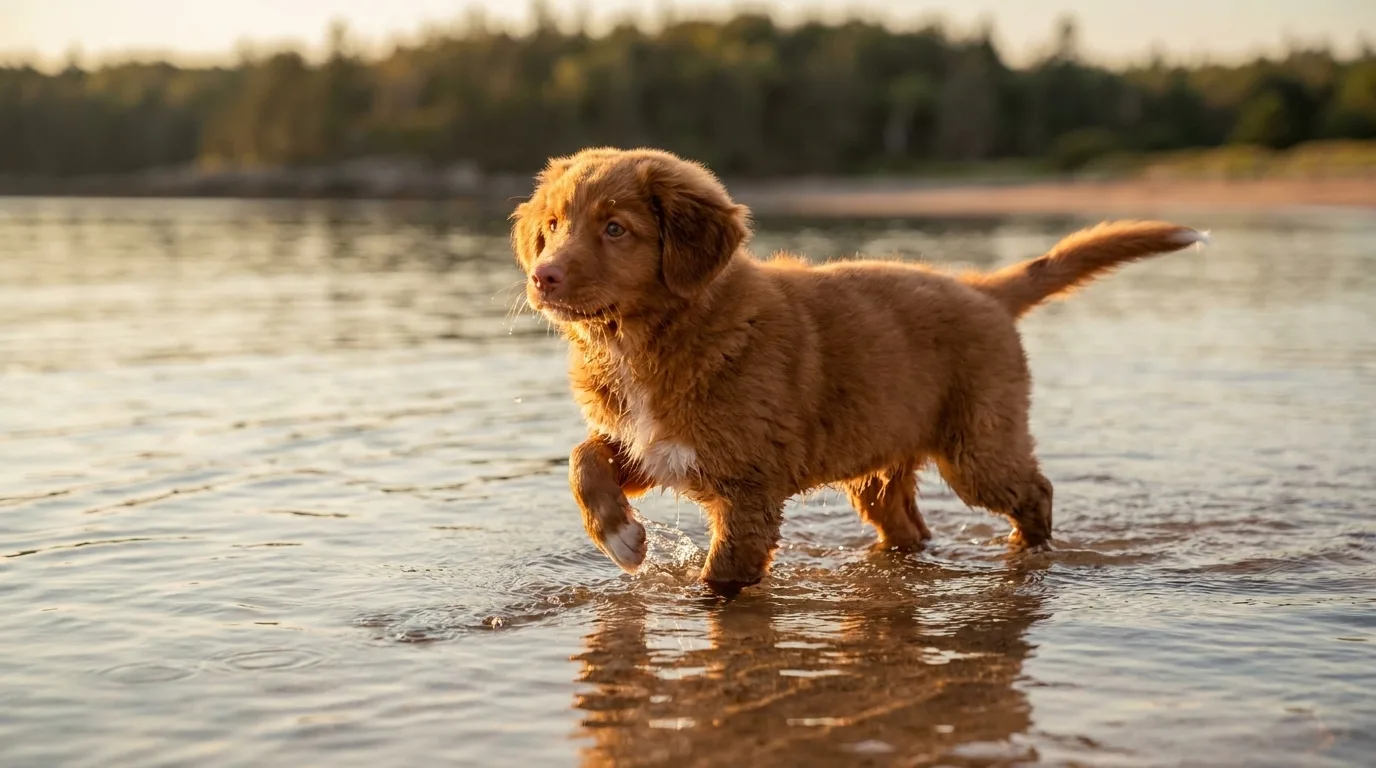
We picked the evening carefully. Late August, the tide most of the way out, a shallow cove where the water comes in over warm sand and you can walk forty feet before it reaches your knees. No surf. No current to speak of. The sort of water that does not do anything sudden.
Crosby stood at the edge of it with his feet going and his head perfectly still, which is a thing young dogs do when the body has already decided and the brain is asking for one more minute.
I did not call him in. I did not carry him in. I took my shoes off and walked out to about shin-depth, turned around, and got on with the enormously important business of looking at the water.
What people get wrong about retrievers and water
There is a belief that retrievers come pre-installed — that you can take a Toller to a lake, toss him in, and the breeding will do the rest. The first half is nearly true. The drive is absolutely in there, and most of them will be swimming within a minute of deciding to.
But deciding is the part people skip. A dog who ends up in deep water before he chose to go there learns something about water that he did not need to learn, and I have met adult dogs of water breeds who would not go past their elbows because of one well-meaning afternoon years earlier. You cannot argue a dog out of that afterwards. You can only avoid teaching it in the first place.
So the first swim is not a swimming lesson. Your puppy does not need to be taught the stroke; it is in there with the webbed feet and the double coat. The only thing you are teaching on day one is far simpler and far more important: the water is a good place, and going into it is always your idea.
The way in
He came out to me because he always comes out to me — that is the whole of his character, and on that evening it did the work for both of us. Three steps, stopped. Two more, stopped. A long considering look at a piece of seaweed. Then up to his chest and visibly delighted about it, smacking at the surface with a front paw to see what it did.
That went on for a while and I let it. Every minute a puppy spends happily wading is a minute of water being perfectly safe.
The swim itself happened almost by accident, which is how it should happen. I had drifted out another few steps, he followed without much thought, and somewhere in there the bottom quietly went away from under him. There was a half-second of scrabbling — the front end working hard, the back end not yet consulted — and then it all smoothed out and levelled off, and a dog who had never swum in his life was swimming, in a tidy little circle around me, with his ears floating out on either side like something left over from the design process.
He looked, if I am honest, slightly astonished.
Then we went back to shore, because the other half of a good first swim is stopping early. He got perhaps thirty seconds of the real thing on the first evening. Swimming is genuinely hard work for a young dog and the water takes heat out of them faster than the air does, and there is nothing to be gained and a fair bit to lose by letting the first time run until he is cold and tired. We walked the beach instead, and he carried a piece of kelp around like a trophy, and the whole thing finished while it was still the best idea anyone had ever had.
What I would tell anyone doing this
Choose the water before you choose the day. You want warm, calm, and shallow, with a gradual bottom and an easy way out — a sloping beach or a cove, not a dock, not a steep bank, not anywhere a puppy could get in and then not find the exit. Let the first session be about wading, and if the swim does not happen, nothing has gone wrong.
Go in yourself if the water allows it. You are the reason he is brave, and no toy ever thrown has been as persuasive as a person already standing in the sea looking pleased about it. A confident older dog works nearly as well, as long as the pair of them stay out of each other's way.
And keep the retrieving for later. Throwing something into deep water on the first day asks a puppy to choose between two strong instincts while his feet are off the bottom, and that is how a dog ends up out of his depth in both senses. The fetch can wait a fortnight. It is not going anywhere, and neither is the drive.
Why it matters more for this breed
Every retriever benefits from a good first swim. For a Toller it is closer to a birthright. This is a dog developed on exactly this shoreline to work exactly this water — dashing at the edge of it, turning in it, going out through it after a bird and coming back through it again, all day, in weather nobody else wanted. The whole job happens where the land stops.
And it is the one place the engine finally empties. Twenty minutes of swimming will do what an hour on a trail cannot, and for a breed that is otherwise very difficult to tire, access to water is not a luxury. It is close to a management strategy.
Which is why that cove on a warm August evening matters so much more than ten minutes ought to. Get it right and you have handed your dog the thing his great-grandparents were made for, and yourself the single most useful tool you will own for the next fifteen years.
Get it wrong and you spend those same fifteen years at the edge of the water with a dog who would rather not, watching him want something he has decided he is afraid of. It is such a small investment to avoid that. An evening, a shallow cove, and the patience to let it be his idea.
He swam most days that autumn. He has not stopped since.
The practical version
The full safety guide — cold water, tides, algae, salt water, over-retrieving and the after-swim routine.
Water safety, in short
- Warm, calm, shallow water with a gentle slope and an obvious exit
- Short first sessions — swimming tires a young dog fast
- Cold water pulls heat out quickly; watch for shivering
- A life jacket for boats, depth, or any current
- On the coast, know the tide and the undertow before the dog does
- Avoid still, warm fresh water with surface scum — blue-green algae can be dangerous to dogs
- Rinse off salt and sand, then dry the ears properly
- Take breaks during repeated retrieves so he is not swallowing water all afternoon
The breed and the water
Born to splash — the webbed feet, the coat, and the enthusiasm that turns every puddle into an ocean.
Raising a puppy?
The socialization timeline covers when to introduce water alongside everything else in the first sixteen weeks.
Keep reading
Born to splash
The water-obsessed world of the Duck Toller, and the equipment behind it.
The dance of the decoy
What all this water work was actually for, on a Nova Scotia shoreline at dawn.
Puppy socialization timeline
What to introduce and when, through the first sixteen weeks.