
Stories
The dance of the decoy
There is a moment by the water’s edge when a Toller stops being just a dog and becomes a blur of copper and white — a hypnotic dance that has lured waterfowl, and captured human hearts, for generations.
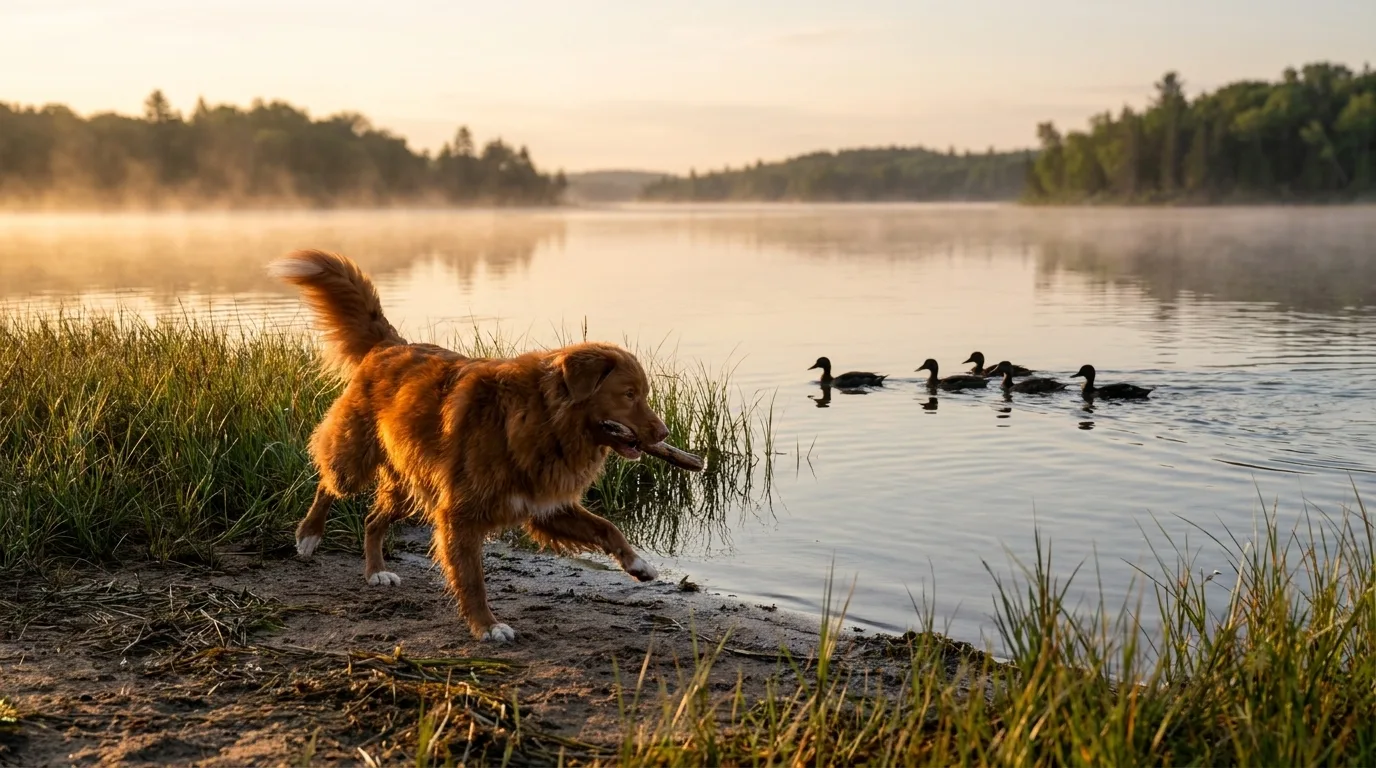
Every gun dog has a job you can explain in one word. Pointers point. Flushers flush. Retrievers retrieve. Then there is this breed, whose ancestral job description — and I want to be clear that I am not making this up — is be interesting.
Not fast. Not fierce. Not even quiet, particularly. Interesting. The Toller is the only sporting dog in the world whose work is, in the strictest sense, theatre.
The strangest job in dogdom
Here is how tolling works. The hunter hides in a blind at the shoreline and tosses a stick along the water’s edge. The dog goes after it — bounding, darting, flashing in and out of the tall grass, tail swinging like a banner, utterly absorbed in the game and paying the water no attention whatsoever. And out on the bay, something improbable happens: the ducks come closer.
Not fleeing. Approaching. Wakes rippling, heads up, drifting in like an audience finding better seats. Waterfowl, whose entire survival strategy is distance, will paddle toward a dancing red dog to get a longer look at it. When the birds are near enough, the hunter rises, the ducks flush, and the dog — who has been theatre until this exact moment — becomes an ordinary retriever for the finale.
The fox's trick, borrowed
The hunters of Nova Scotia did not invent the dance. They stole it — from the fox, which had been running this exact routine on shorelines long before anyone thought to breed for it. A fox frolicking oddly at the water’s edge draws in curious ducks; the old accounts say some foxes worked in pairs, one performing while the other waited in the reeds. The Acadian hunters of Yarmouth County watched all this and asked the obvious question: what if the fox worked for us?
So they built one. A compact red dog with a white-tipped tail — fox-marked, fox-sized, fox-quick — with the retrieving instinct stitched in for the second act. Why the ducks come remains half a mystery; curiosity, mobbing instinct, the pull of something that does not behave like a predator should. The birds have never explained themselves. The dance predates the theory, and has never needed it.
The dance, performed daily
Nobody taught my dogs any of this, which is the part that still stops me. But watch a Toller play fetch on any shoreline and the whole choreography is right there, intact, running on two-hundred-year-old instructions: the sideways bound, the sudden freeze, the head-flag, the delight in being seen. It is the same reason they treat water as a birthright — none of it needed teaching. It only needed a shoreline to happen in front of.
I have watched the gulls drift in, low and curious, while a red dog danced after driftwood at the tide line. The gulls have no idea they are answering a question first asked before Confederation. Neither does the dog. The dance simply works, on whatever is watching.
Who it really lures
And that is the secret, unraveled: the dance was never really about ducks. It is a trick of pure charisma — motion and joy deployed as gravity, pulling the curious closer — and it does not distinguish between species. The ducks were only ever the first audience.
Everyone who has brought a Toller home has been tolled. You saw a photo, or met one at the end of a dock, or watched a copper blur work a shoreline for exactly as long as it took to drift closer yourself. By the time you understood what was happening, you were in the blind, and the season was open, and it was far too late to paddle away.
The practical version
What tolling is, how it works in the field, and why the breed still carries the whole routine — set out here.
Where the dance came from
The Little River Duck Dog — the Yarmouth County history of the breed, from Acadian shorelines to kennel-club recognition.