Stories
From Yarmouth shores to modern homes
Long before kennel clubs learned their name, these fiery little retrievers were the best-kept secret of Acadian hunters — bred to thrive on the harsh, beautiful coasts of Canada’s Maritimes, and very nearly lost before the world found out.
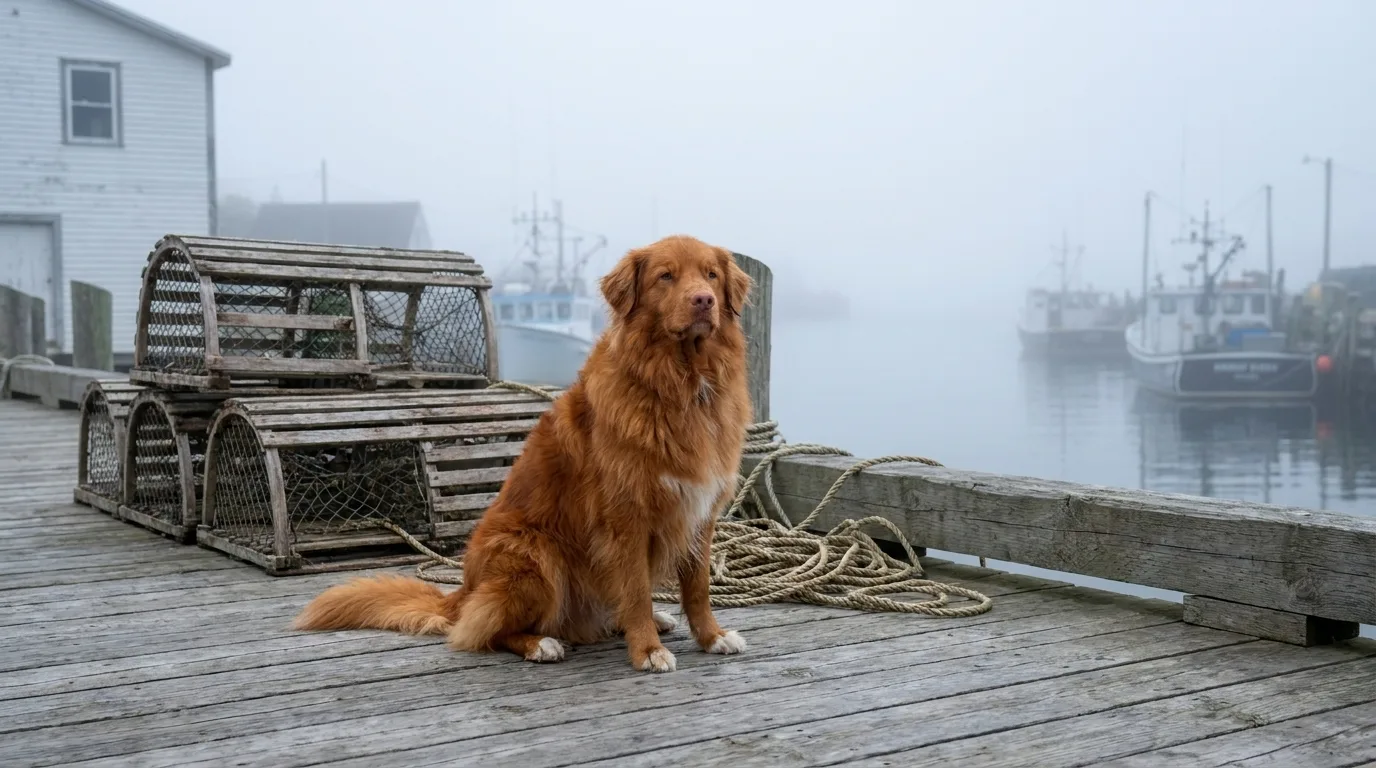
Most breeds are named like products. This one is named like directions: Nova Scotia Duck Tolling Retriever — a province, a bird, a technique, a job. It is less a name than a set of coordinates, and if you follow them, they lead to one small corner of one county at the southwestern tip of Nova Scotia, where for the better part of a century the best duck dog in North America existed without papers, without publicity, and without a name anyone beyond the county line would have recognized.
The best-kept secret in the Maritimes
They called it the Little River Duck Dog, after the harbour district in Yarmouth County where it took shape in the early 1800s. There were no studbooks on those shores and nobody thought to keep any — these were working dogs of working families, Acadian and settler hunters who bred the dog that filled the boat to the other dog that filled the boat, and let the results argue for themselves. What went into the recipe went unrecorded; what came out was consistent enough to breed true: a compact red dog with a fox’s coat and quickness, cold-proof, water-mad, and born knowing a very strange dance.
For generations, that was the whole story. The dog worked the tide line at dawn, rode home in the dory, and slept by the stove. The wider world of dogs — the shows, the registries, the fanciers — had no idea it existed.
Nearly lost
A breed that lives in one district, tied to one fading style of hunting, kept by a handful of families who write nothing down, is a breed standing very close to the edge. The Toller was never numerous. When the modern breed was finally assembled and registered, it passed through a needle’s eye — a founding population so small that every Toller alive today descends from a handful of those Yarmouth County dogs.
It is worth pausing on how easily this goes the other way. No wider public knew the breed existed, so no wider public would have missed it. The dance, the coat, the scream, the whole two-hundred-year inheritance — all of it sat, for decades, in the kennels of a few coastal families, one hard stretch away from simply not being here.
The long road to a long name
The turn came in 1945, when Colonel Cyril Colwell of Halifax — who had fallen for the little red dogs and spent years championing them — saw the breed formally recognized by the Canadian Kennel Club under its grand new name. Recognition, though, is not fame. The Toller spent decades more as a Maritime curiosity, known to hunters and hardly anyone else, while its breeders quietly kept the line alive.
Then, in 1980, two Tollers took Best in Show at all-breed championship events — the little secret beating the famous breeds at their own game — and the world finally looked up. In 1995, Nova Scotia declared the Toller its provincial dog, the province putting its name on the dog that had carried the province’s name all along. Full American Kennel Club recognition followed in 2003: the smallest retriever, and the last to arrive, roughly two centuries after it went to work.
The legacy in the living room
Here is what I think about, watching a Toller asleep on a couch a long way from any duck blind: nothing was lost in the move. The engine is intact. The water madness is intact. The dance still runs on its old instructions, performed now for gulls and tennis balls. Every quirk in a modern Toller is a line of unwritten history from those shores, faithfully transmitted, still legible after two hundred years.
The families of Little River Harbour never wrote their breed book. They wrote it in the dog instead — and the dog, unlike paper, kept every word.
The practical version
The full documented history — Little River Harbour, the Colwell campaign, recognition, and the modern breed.
The breed today
Breed history & facts traces the line from those shores to the modern standard.