
Stories
Two red dogs: what nobody tells you about the second Toller
One of them follows me from room to room. The other one negotiates. After years with a pair, here is the honest answer to the question I get asked most — does a second Toller make the first one easier?
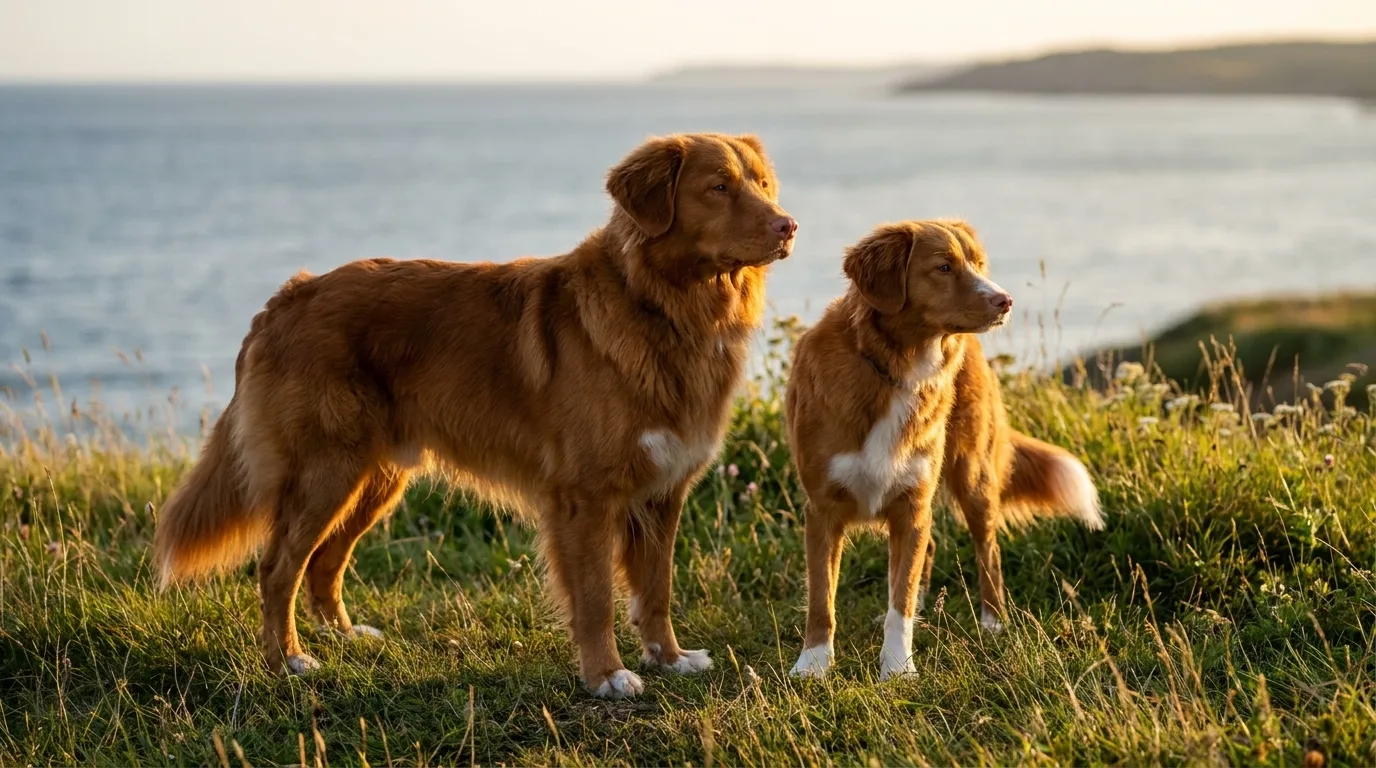
You can tell them apart from the far end of a field, and not just by size. Crosby comes back in a straight line. Ember comes back by a route of her own choosing, having checked two or three things on the way that she felt I should know about.
People ask me about this constantly — usually some version of the same question. We love our Toller. Should we get another one? And underneath it, almost always, a quieter hope: that a second dog might take some of the work off the first.
I will give you the honest answer, and then the long one.
The two of them
Crosby is the bigger of the two, deep copper right through, with the full plush coat the breed is supposed to have and a face that is red from his ears to his nose without a single white hair interrupting it. He is the one who assumes he is on the team. Pick up a jacket and he is at the door. Walk to the mailbox and you have an escort. There is no calculation in him at all; he simply cannot imagine an outing that would not be improved by a dog.
Ember is smaller, neater, built like a dog who has somewhere to be. She has a small white snip on her muzzle, white socks on her front legs and a white tip on her tail that you can follow through long grass like a flag. And where Crosby accepts, Ember negotiates. Ask her for a sit and you will often get one, after a brief pause in which she appears to be checking whether sitting is in her interests today. She is not disobedient. She is running the numbers.
What is remarkable is how little they have changed each other. I half expected the younger habits to rub off, in one direction or the other. They never did. The same house, the same routines, the same walks — and they remain two completely distinct dogs who happen to be extremely fond of each other.
What two Tollers actually give each other
A lot, and most of it is quiet. They sleep touching. They have a whole vocabulary for play that neither of them uses with me — the exaggerated bow, the sideways bounce, the mock-serious growl that fools nobody. On a long walk they move as a unit without ever discussing it, one swinging wide while the other holds the line, which is almost certainly some ancient working instinct expressing itself on a Nova Scotia trail with no ducks involved whatsoever.
Two dogs also means nobody is ever truly alone in the house, and for a breed this socially wired that counts for something real.
But here is the part people do not want to hear.
What a second dog does not fix
A second Toller will not exercise your first Toller. Two dogs playing in a yard is a lovely thing to watch and it is not a substitute for a proper outing — they will wrestle for fifteen minutes and then both come and ask you what the actual plan is. The daily exercise requirement does not get shared between two dogs. It doubles.
A second dog will not fix boredom either. Tollers need work for their minds, and another dog is company, not occupation. Two bored Tollers are not half as much trouble as one bored Toller; they are considerably more, because now they have a collaborator.
And a second dog is not a treatment for a dog who struggles when you leave. This is the one I feel strongly about, because people try it and are disappointed. A dog who worries about your absence is not reassured by the presence of a different dog — and if the alone-time skill was never taught in the first place, you can simply end up with two dogs who need teaching instead of one.
The honest arithmetic
Everything doubles. Food, grooming, vaccinations, boarding, insurance, the eye-watering emergency visit that arrives without warning. Two Tollers in full coat blow is a genuine household event. And the scream, which is memorable enough from one dog, has a harmony part when two of them see the leash come off the hook.
The less obvious cost is time, and specifically separate time. Two dogs trained only as a pair become a pair that cannot function apart — they take their cues from each other instead of from you, and a recall that works beautifully in the yard evaporates the moment one of them decides otherwise and the other agrees. So they get walked alone sometimes. Trained alone, always. Vet trips alone. It is more work than people picture, and it is the single thing I would tell anyone adding a second dog of any breed: keep two relationships, not one relationship with a committee.
So should you?
Here is the test I give people, and it has nothing to do with whether you can afford it.
Is your first dog finished? Not perfect — finished enough. Solid recall, decent manners, settled in the house, happy to be left for a reasonable stretch. A second puppy does not learn your rules from you; it learns them from the dog already in residence, and it copies everything indiscriminately, the good habits and the ones you have been meaning to deal with since spring. Add a second dog to a solid first dog and the first dog does half your work for you. Add one to a project that is still in progress and you now have two projects, moving.
If the honest answer is yes, a few practical notes. Opposite-sex pairs generally settle together more smoothly than two of the same sex. Do not take two puppies at once, however tempting the photograph — raising littermates together is a genuinely hard project that experienced trainers take on carefully and most households should skip. And give the first dog something that is still only theirs: a walk, a spot, a particular evening habit that the new arrival does not get to attend.
Worth it
There is a thing that happens at the end of a long shoreline walk, when both of them are finally tired. They come back to the truck soaked and sandy and perfectly pleased with themselves, and they stand there a moment, shoulder to shoulder, breathing hard, two red dogs who have had exactly the day they were built for.
Would one dog have been easier? Yes. Considerably. Nobody adds a second Toller to make life easier, and anyone who tells you otherwise has not met the grooming bill. You add a second one because you have room — in your week, in your house, in your patience — for another whole character, and because watching two of them be entirely themselves at the same time is one of the better things on offer in this life.
Just do not expect them to raise each other. That part is still your job, twice over.
The practical version
Male or female for your second? The real differences, and why the temperament match matters more than the sex.
Before you add one
Is a Toller right for you? is worth re-reading before a second one — the honest requirements do not get smaller the second time.
Finding the next one
How to find a reputable breeder — including why a good breeder will ask about the dog you already have.
Keep reading
Negotiating with a Toller
The breed's talent for the counter-offer — and how to win politely.
The shadow with a red coat
The other half of this pair — a dog who simply assumes he is coming.