
Stories
“My puppy cries the whole time I’m gone.” Here’s the gentle fix
A new owner wrote to me about a puppy who fell to pieces behind a closed door. It’s one of the most common questions this site gets — and one of the most fixable. Here’s exactly what I told her.
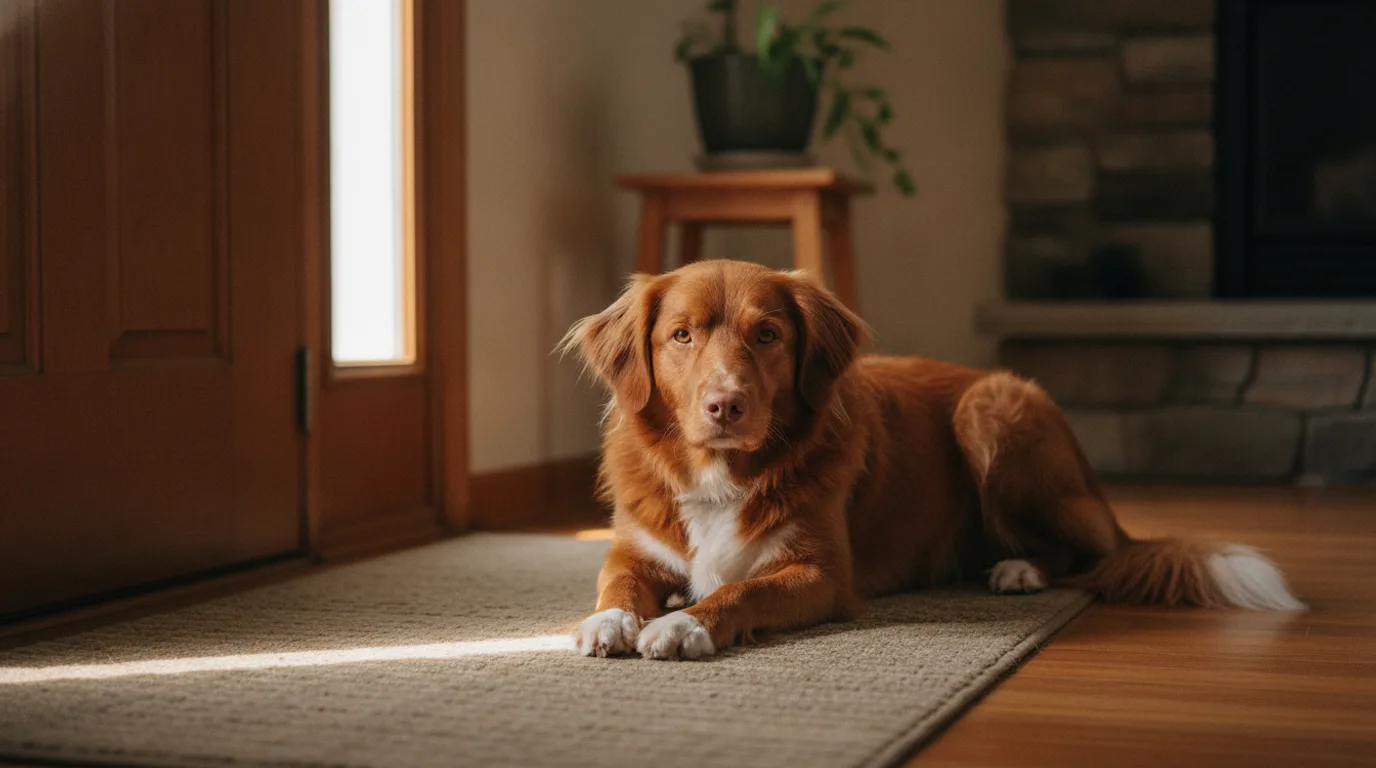
The message came through the site on a Tuesday: a first-time Toller owner, three weeks into life with a puppy, and already worn thin. Every departure was a small heartbreak. The puppy cried at the door when she left, the neighbour reported crying while she was gone, and the guilt was starting to change her plans. Should I just stop leaving? she asked.
I told her the two things I tell everyone who asks. First: this is normal, it is nobody’s fault, and it is very fixable. Second: being alone is not something dogs are born knowing. It is a skill — and like every skill, it is taught in small, kind, deliberate steps.
Why this breed, especially
A Toller was built by two centuries of working beside one person. The shadowing that charms every owner — the escort to the kitchen, the supervision of toast — is the same devotion that leaves a young dog baffled by an empty house. In this house, that devotion once expressed itself as Crosby attempting, with great sincerity, to walk out the front door with me — not worried about being left so much as convinced the outing obviously required a dog. Door manners fixed that. But it tells you what you are working with: a breed that assumes it is on the team.
That is why my own dogs’ calm at the door is not luck, and it is not temperament. It is the result of a routine I have run with every dog I have raised, from their earliest weeks: alone time built from small doses to larger ones, and an exit polished until it is the least interesting thing that happens all day. I leave without any excitement at all — no announcement, no ceremony, no guilty look back. Just gone, calmly, the way you step out to check the mail. Departures in this house are boring by design, and the dogs sleep through most of them.
First, find out which problem you have
Before she trained anything, I had her set up a twenty-dollar camera in the hallway — because there are two very different things that sound the same through a door, and the plan depends on which one is happening.
Most puppies are the first kind: they miss you, they say so, and then they cope — some crying, a lap of the house, a search for entertainment, and eventually a nap. That puppy is ready for the training below, and it will work. A much smaller number cannot settle at all: pacing that never stops, drool on the floor, crying from the first minute to the last. That is true separation anxiety, and it deserves bigger help than a website — your vet first, then a qualified behaviorist, sometimes with medication to steady the nerves while the training works. Asking for that help early is not a failure. It is what a good owner does.
Her camera came back with good news: a puppy who complained, patrolled, complained a little more — and then curled up on the hallway rug to wait. A dog who misses you but copes is a dog you can absolutely teach.
The method: perfect your exit, then stretch the time
What I gave her is the routine my own dogs were raised on, and it is almost embarrassingly simple. Find the length of time your puppy can be alone comfortably — not the length she can endure, the length she barely notices. For a young puppy that might be ninety seconds. Live inside that comfort zone, and stretch it slowly: step out, count, come back before any worry starts. Two minutes becomes five. Five becomes ten. Then a genuinely random shuffle — eight, three, twelve, one — so a departure stops predicting anything at all.
While the time grows, strip the drama out of both ends of it. The exit: no speech, no long goodbye, no fuss — leaving calmly is a skill for the human end of the leash, and it is worth practicing until it is genuinely boring. The return: just as plain. Walk in, hang up your coat, say hello a minute later once four feet are on the floor and the excitement has passed. And in between, retire the props: pick keys up and set them down a dozen times a day, coat on and coat off, until none of it means anything.
Two finishing touches make everything easier. Meet the exercise needs before alone-time practice — a puppy with a full tank finds it much harder to rest. And give departures their own special something: a frozen, food-stuffed toy that appears only when you leave and is quietly put away when you return. Done consistently, the sound of you leaving starts to mean something good is about to happen.
The dog on the mat
I told her progress would not be a straight line, and it wasn’t — a thunderstorm cost her a week, and the fix was the one I always give: drop back to easy, rebuild. But six weeks after that first message, a video arrived. Her puppy watches the door for a moment, collects a toy, carries it to a mat in the front hall — and goes to sleep in a patch of sun, in an empty house, entirely at peace.
Some owners worry, as she did at the start, that teaching a dog to be left is somehow unkind to an animal whose whole profession is being with you. It is exactly backwards. The shadowing is love, but so is the mat by the door — because a dog who can rest while you are gone spends none of his life worried. Alone is not the opposite of together. It is just the part where they wait comfortably, certain you are coming back. And every time you open that door, you prove them right.
The practical version
The full method — the camera test, the alone-time ladder, departure cues, what to skip, and the signs it’s time to bring in a professional — is laid out step by step here.
The departure toy, and more
Brain games & enrichment covers the food puzzles and settle work that make alone-time easier — and the rest of a Toller’s mental workout.
Raising a puppy right now?
Alone-time practice is built into the first-week plan of The Whole Family Puppy Training Book — along with the rest of the routine my own dogs were raised on.
Keep reading
Separation anxiety & alone time
Worry or true anxiety? The camera test, the ladder, and when to bring in help.
The shadow with a red coat
The devotion behind the door drama — why they follow in the first place.
Puppy first week
Where alone-time practice begins — the plan for the first seven days.