
Breed Library
Meet the retriever family: all six retriever breeds
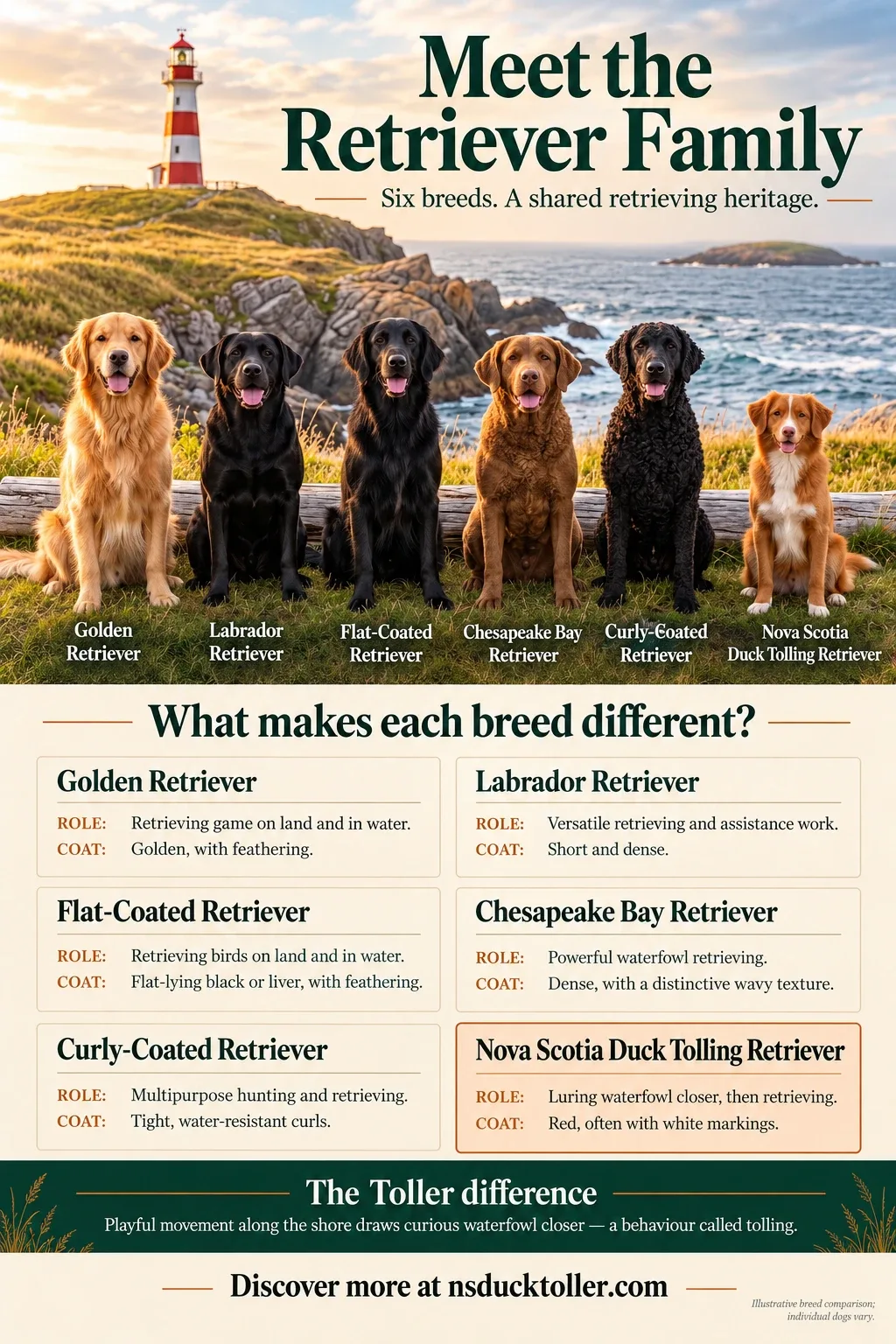
Six breeds carry the name “retriever,” and every one of them was built around the same idea: find the bird, bring it back, undamaged, from land or water. They differ in size, coat, and country — and one of them does something none of the others do. It doesn’t wait for the ducks. It goes out and fetches them in.
How many retriever breeds are there?
Six. The American Kennel Club and the Canadian Kennel Club both recognize the same half-dozen: the Golden Retriever, the Labrador Retriever, the Flat-Coated Retriever, the Chesapeake Bay Retriever, the Curly-Coated Retriever, and the Nova Scotia Duck Tolling Retriever.
They are a young family as dog breeds go. Most were formalized in the nineteenth century, when breech-loading shotguns made wing-shooting popular and hunters suddenly needed a dog that could mark where a bird fell, swim out through cold water, and deliver it back to hand undamaged. Every retriever on this page is a variation on that one job.
Two of the six come from Atlantic Canada. The Labrador traces back to the St. John’s water dogs of Newfoundland before it was refined in England, and the Toller was developed in Yarmouth County, Nova Scotia — a point of some pride around here.
The short version
- Golden — land and water, feathered golden coat
- Labrador — the versatile all-rounder, short dense coat
- Flat-Coated — the perpetual puppy, flat black or liver
- Chesapeake Bay — the cold-water powerhouse, wavy oily coat
- Curly-Coated — the oldest and rarest, tight curls
- Toller — the smallest, red, and the only one that lures
The six retrievers at a glance
Sizes are approximate — consult each breed’s standard for exact figures.
Approx. 21–24 in · 55–75 lb
Approx. 21–24½ in · 55–80 lb
Approx. 22–24½ in · 60–70 lb
Approx. 21–26 in · 55–80 lb
Approx. 23–27 in · 60–95 lb
Approx. 17–21 in · 35–50 lb
What sets each breed apart
Same job description, six different answers to it.
Golden Retriever
The sociable one. Bred in the Scottish Highlands for upland and water retrieving, the Golden became the template for a family dog: biddable, affectionate with nearly everyone, and forgiving of a novice handler. The feathered coat needs regular brushing and sheds generously.
Labrador Retriever
The all-rounder. Descended from Newfoundland’s St. John’s water dogs and refined on English sporting estates, the Lab does everything — gundog, guide dog, detection dog, family dog. With the Golden, one of the two most popular retrievers by a wide margin.
Flat-Coated Retriever
The optimist. A glossy black or liver dog with a long, elegant head that holds onto its puppyhood longer than most breeds hold onto anything. Capable in the field and cheerfully uninterested in growing up — which charms some owners and exhausts others.
Chesapeake Bay Retriever
The tough one. Developed on America’s Chesapeake Bay for long days in frigid, choppy water, the Chessie carries an oily wavy coat that sheds water like a duck’s back. More reserved with strangers and more protective than the other retrievers.
Curly-Coated Retriever
The rare original. One of the oldest retriever breeds and now among the least common, the Curly wears a coat of tight crisp curls over almost the whole body. Independent, discerning with strangers, and a confident multipurpose hunting dog.
Nova Scotia Duck Tolling Retriever
The lure. The smallest retriever and the only one with a second job: playing along the shoreline to draw curious ducks within range, then retrieving them once the shot is taken. Red, foxy, intense, and famously vocal. Read the full breed profile.
The Toller difference: what tolling actually means
Five of the six retrievers wait. The hunter calls the birds, takes the shot, and sends the dog. The Toller was bred to work before the shot.
Working the shoreline in front of a concealed hunter, the dog dashes, turns and plays — chasing a thrown stick in and out of cover, flashing that white-marked red coat through the grass. Ducks rafted safely out on the water see movement they cannot identify, and curiosity does the rest: they swim closer to investigate. Only then does the hunting begin, and only then does the Toller become an ordinary retriever and go and collect what was shot.
The behaviour is widely thought to mimic the way a fox works a shoreline, and it explains why the breed looks the way it does: small enough to read as fox-like, red enough to catch an eye at distance, and busy enough to keep performing. Everything that makes a Toller demanding in a living room — the drive, the noise, the refusal to be bored — is that job, still switched on.
Smallest of the six
At roughly 17–21 inches and 35–50 pounds, the Toller is meaningfully smaller than every other retriever — commonly 20 to 30 pounds lighter than a Labrador. Owners who expect a scaled-down Golden are surprised twice: once by the size, and again by the temperament.
Rarest of the six?
The Toller and the Curly-Coated Retriever are the two you are least likely to meet at a dog park. Are Tollers rare? covers what that scarcity means for waiting lists and prices.
Thinking about a Toller? Compare it properly
Honest head-to-head comparisons — written to talk you out of the breed if that is the right answer.
Toller vs Golden Retriever
The comparison most people start with — and the one that causes the most surprises.
Read the comparisonToller vs Labrador Retriever
Smaller, sharper, louder. Which retriever actually suits your household.
Read the comparisonToller vs Border Collie
For anyone weighing one intense working breed against another.
Read the comparisonToller vs Australian Shepherd
Two clever, driven dogs with very different ideas about strangers.
Read the comparisonIs a Toller right for you?
The honest self-check that comes before any breed decision.
Read the guideBreed Library
The complete Toller profile: origins, standard, traits, temperament and health.
Read the library