
Puppy Portal
Going home day: traveling with a new puppy, hour by hour
A drive from the breeder, a flight, and the last miles home — often eight or ten hours end to end, and the biggest day of your puppy’s short life so far. Done well, it is safe, calm, and one of the loveliest days you will ever have. Here is the whole plan, and what is actually happening to the puppy while it unfolds.
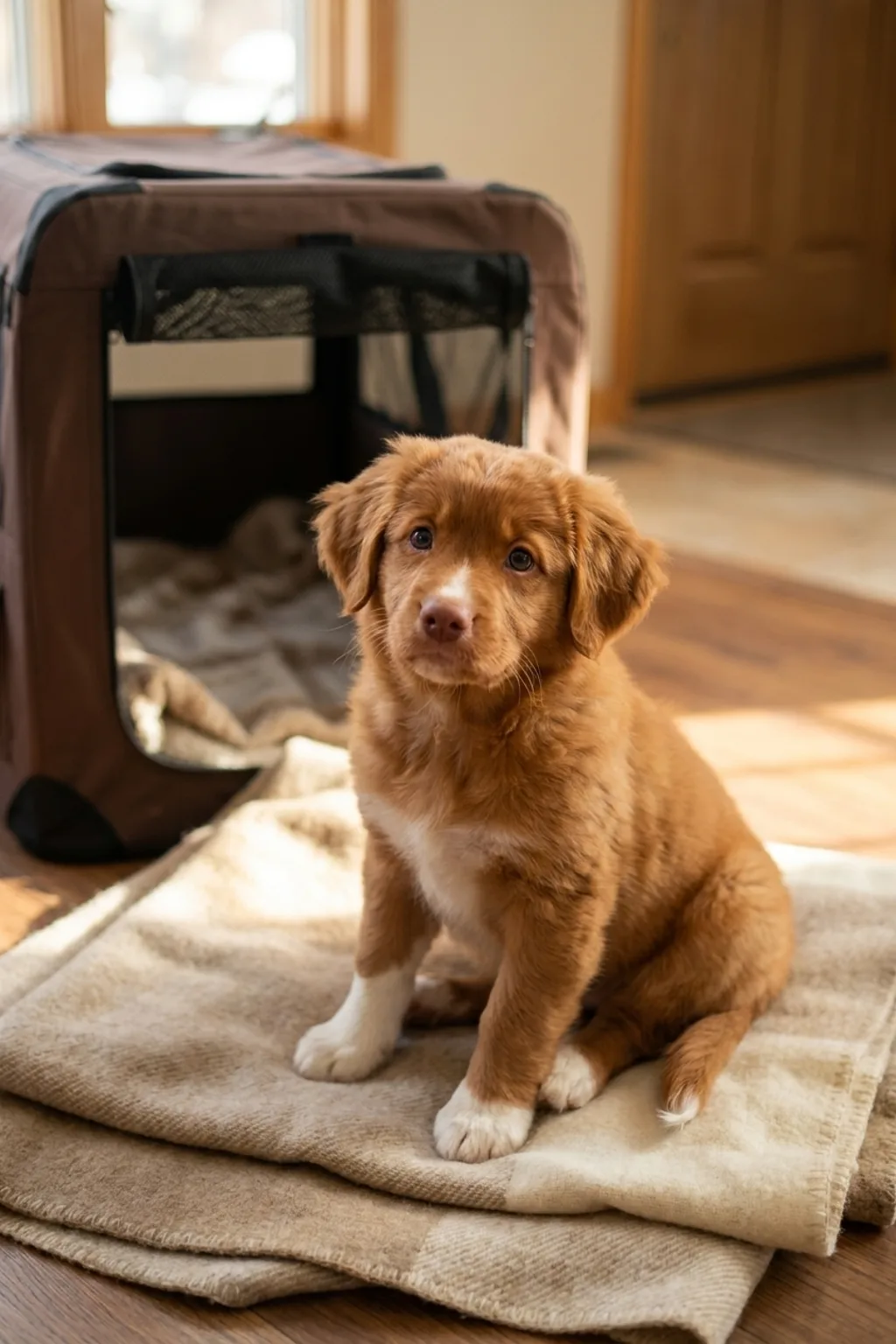
- Plan the day in 2–3 hour legs
- Water at every stop; potty every 1½–2 hours
- Use your own pad or towel — not public grass
- Bring bedding that smells like the litter
The short version
Break the journey into legs of two to three hours and treat the gaps between them as the real work: a potty attempt, water offered, a quick body check, a few quiet minutes of contact. Feed a small meal about three hours before you set off and nothing large again until you are home. Keep the puppy secured in a carrier or crate for every mile — car and cabin both. And carry a scrap of bedding from the whelping box, because the one thing you cannot buy for this day is the smell of home.
Because Tollers are a genuinely scarce breed, most owners do not get to drive across town for their puppy. Long going-home days are the norm here, not the exception — which is exactly why they are worth planning properly.
The thing most people forget
Ask your breeder, a week ahead, to set aside an old towel or small blanket that has been in with the litter — and not to wash it. It will smell of the mother and every sibling your puppy has ever slept against. It is the most effective comfort item you will carry, and it costs nothing.
What this day is like from down there
Understand the passenger and the whole plan makes sense.
Everything is new at once
In a single morning: the first car, the first road noise, the first strangers, often the first airport. Until today the world was one room, one yard, one familiar set of smells. A puppy has no way to know any of it is temporary — so the calmer and more boring you keep each step, the smaller the day feels.
They have never been alone
For eight weeks your puppy has slept in a pile of warm siblings, eaten shoulder to shoulder with them, and never once been by themselves. Today that pile is gone. It is the single biggest change of the day, and nothing in the carrier can quite replace it — which is why you become the replacement, starting now.
Sleep is how they cope
An eight-week-old needs upwards of eighteen hours of sleep a day, and a puppy who sleeps through a flight is not shut down — that is exactly what you want. Wake them for water and potty stops, then let them go straight back. Resist the urge to pass them around for cuddles at every opportunity.
Before you go: the bag and the booking
If you are flying, the paperwork starts weeks out, not days. Book the in-cabin pet space at the same moment you book your own seat — most airlines cap the number of animals per flight, and those spaces go early. Confirm three things in writing while you are there: the minimum age they will accept, the exact carrier dimensions for your aircraft, and whether they require a veterinary health certificate and how recently it must be issued. Requirements differ by airline and by route, and the counter is a terrible place to discover a surprise.
Then ask your breeder for the practical handover: what and when the puppy last ate, the current feeding schedule, enough of the same food for the first week or so, the vaccination and deworming record, microchip details, and registration paperwork. Take a photo of the feeding instructions on your phone as a backup. Nothing upsets a new puppy’s stomach faster than an abrupt food change on top of a travel day — keep them on the breeder’s food and transition slowly over a week to ten days once you are home and settled.
Book the earliest sensible departure. A day that starts at seven gives you daylight, cooler temperatures, room for delays, and a puppy arriving home with an hour or two to explore before bed.
The going-home bag
- Airline-approved carrier (car crate too, if driving far)
- Puppy pads — more than you think
- Two old towels and a plastic bag for the used one
- Paper towel, wipes, enzyme cleaner, poop bags
- Collapsible bowl and a bottle of the water they know
- The breeder’s food, plus a few small treats
- Unwashed bedding from the litter
- Flat collar with ID, and a light slip lead or harness
- Health record, health certificate, microchip number
- A change of clothes for you. Trust me on this one.
Leg one: the drive from the breeder
Say your goodbyes inside, then get moving. Drawn-out farewells in the driveway help the humans and do nothing for the puppy, who is better served by starting the day than by standing in it.
The puppy travels in a secured carrier or crate — belted in on a back seat or wedged in the footwell so it cannot slide, never in the front seat with an active airbag, and never loose on a lap. A puppy held in someone’s arms is a puppy who can be dropped, can wriggle under the pedals, or can be badly hurt by a modest bump. If there are two of you, the passenger sits beside the carrier where a hand and a low voice can reach in. Keep the car cool and the radio down.
Expect the first twenty minutes to be the loudest of the day. Most puppies protest, then find the motion soothing and sleep. Let the crying run its course rather than lifting them out to soothe it — the lesson you want them learning is that a carrier is a safe place where nothing bad happens, and that lesson pays back every day for the next fifteen years.
Motion sickness
Puppies are more prone to car sickness than adult dogs — the inner ear is still developing. Watch for drooling, lip-licking, yawning, and restlessness before the vomiting starts.
What helps: a light meal well before departure rather than a full one, cool fresh air, facing forward, and a carrier that damps the motion. For a genuinely long haul, ask your vet in advance about a prescription anti-nausea medication. Ask the same vet about sedatives and you will likely be told no — sedation is generally discouraged for air travel, and a groggy puppy is harder to assess, not calmer.
The flight
Shorter and duller than you fear, if the groundwork is done.
Before the airport
Offer water and a proper potty attempt in the car park — on your own pad or towel — before you go inside. Skip the big drink right before boarding; small sips are kinder than a full bladder at thirty thousand feet. Keep the carrier zipped and your hands free.
Through security
The carrier goes through the scanner empty and your puppy comes through in your arms, which is the single moment of the day they could slip away from you. Have the collar on and a slip lead or harness attached before you join the queue, and hold them against your chest, not out in front of you.
In the cabin
The carrier stays under the seat in front for the whole flight — that is the rule, and it is also the best place for them: dark, close, and warm. A hand resting on the mesh and a few quiet words on takeoff is all the reassurance most puppies need. Airport pet relief areas are heavily used by other dogs; with an unvaccinated puppy, your own pad in a quiet corner is the safer choice.
Water, potty, food: the rhythm between the legs
This is the part that turns a long day into an uneventful one. At every single stop, in this order: potty attempt first, then water, then a quick check of the puppy and the carrier, then back on the road.
Water. Offer small amounts often rather than a full bowl occasionally — a splash in a collapsible bowl every couple of hours. A puppy who is too wound up to drink will often take an ice cube or lick water from your fingers, and both count. Bring water from the breeder’s tap if you can; some puppies are fussy about a change in taste on a day when everything else has already changed.
Potty. The rough guide for how long a puppy can hold it is one hour for every month of age, plus one — so about three hours at eight weeks, and less when they are anxious or have just drunk. On a travel day, offer the chance every ninety minutes to two hours and do not be discouraged by a puppy who does nothing; some hold on all day out of sheer overwhelm and then go the moment they meet grass at home. Expect accidents in the carrier, and pack for them without a flicker of annoyance. This is not a training failure. It is a baby on the longest day of their life.
Food. A small meal about three hours before departure, then nothing substantial until you arrive. A skipped meal on travel day is normal and not a cause for alarm; a few treats or a scattering of kibble at a stop keeps their energy up without filling a moving stomach. If your journey runs long past a scheduled mealtime, a small portion at a quiet stop is better than waiting hours.
Where they should not go
Your puppy’s vaccination series will not be complete until around sixteen weeks, and parvovirus lingers in soil and on surfaces for a long time. Highway rest stops and airport relief areas are the most dog-trafficked ground in the country.
Carry your own puppy pad or towel and use that instead. If your puppy will only go on grass, pick an out-of-the-way patch well away from the marked dog area, carry them to it, and carry them back.
Never, even for a minute
Do not leave a puppy alone in a parked car. Not for a coffee, not in mild weather, not with a window cracked.
Comfort, and the signs worth watching
Comfort on this day is made of small, dull, consistent things: the litter blanket in the carrier, a worn t-shirt of yours added to it so the two smells start to blend, a low steady voice, and the same pair of hands doing the lifting. Skip the squeaky toy — a soft chew is better company in a carrier — and resist handing the puppy round the family at the arrivals gate. There will be years for that. Today they need one person, one smell, and a lot of sleep.
Most puppies travel beautifully. Still, know what would make you stop and find a vet rather than push on: repeated vomiting, watery or bloody diarrhoea, a puppy who will not take any water for several hours, gums that look pale or feel tacky, or a limpness that does not lift after a proper rest. Look up the number for a clinic near your destination before you leave, so that if you ever need it you are dialling rather than searching.
Warm, not hot
Puppies regulate temperature poorly. Aim for a carrier that is cosy but ventilated, and check it whenever the environment changes — a sunny car window, an air-conditioned terminal, a cold cargo-side jet bridge. Panting and a hot-feeling belly mean too warm; shivering and burrowing mean too cool.
The last miles, and the front door
The final drive is the one where people relax and hurry. Do the opposite: this is when a tired puppy is most likely to be sick, so keep the pace gentle and the car cool.
When you get there, do not go inside first. Carry your puppy straight to the patch of ground you intend to use as the toilet spot for the next year, put them down, and simply wait — two minutes, five, however long it takes. Praise quietly when it happens. That is your first successful house-training repetition, and it took no training at all.
Then: a quiet house, no welcome party, no parade of neighbours. A small meal if a mealtime is near, water available, a slow potter around one or two rooms, and sleep. Everything you are itching to do — the introductions, the photographs, the first walk — will still be there tomorrow, and your puppy will be a far better version of themselves for having had a long night first.
Next: the first week
What to do from the moment you walk through the door — the first night, the crate, the schedule, and the week that sets the tone.
Still getting ready?
Puppy essentials covers the gear worth buying before the trip — including the carrier and crate you will use on the day.
The most beautiful day
There is a moment, somewhere in the last hour of the drive, when the noise stops. The puppy who protested the carrier at nine in the morning is asleep on a blanket that smells of a barn a province away, and the car is quiet, and it dawns on you that this small stranger is now yours to look after for the whole of their life. In my experience there are very few days better than that one. I would put going-home day among the best days I have had with any dog, and I have never once regretted taking the long route home to make it a gentle one.
It is worth holding one thing in mind while you enjoy it. This morning your puppy woke up in a heap of brothers and sisters, the way they have woken up every single day of their life. Tonight they will sleep alone for the first time. When they cry at two in the morning — and they will — it is not stubbornness and it is not a problem to be corrected. It is an eight-week-old asking for the pile.
Which is the quiet, lovely job of the next few weeks: you become the pile. The crate near your bed, the hand hanging down where a nose can reach it, the same voice at every waking. Do that, and within a fortnight the puppy who left one family will have settled completely into another. That is not a loss you are managing. It is the beginning of the best thing about owning this breed, and it starts on a day you will remember in detail for years.
Drive carefully. Stop often. Enjoy it — you only get one going-home day per dog.
The full puppy plan
Everything from choosing a breeder to the first year, in one place.
Training from day one
The routine my own dogs were raised on — including crate and alone-time work — is set out week by week in The Whole Family Puppy Training Book.
Related resources
The first week home
The night you arrive, the crate, and the seven days that set the tone.
Read the guideSocialization timeline
Where to take a puppy, when — and where not to, before the shots are done.
Read the guideSources
Trusted references for travel, health, and breed guidance.