
Stories
The sound and the fury: surviving the infamous Toller scream
It starts as a high-pitched trill and erupts into a sound that can stop a clock — a vocal expression of pure, unadulterated joy that every Toller owner learns to love, and sometimes dreads explaining to the neighbours.
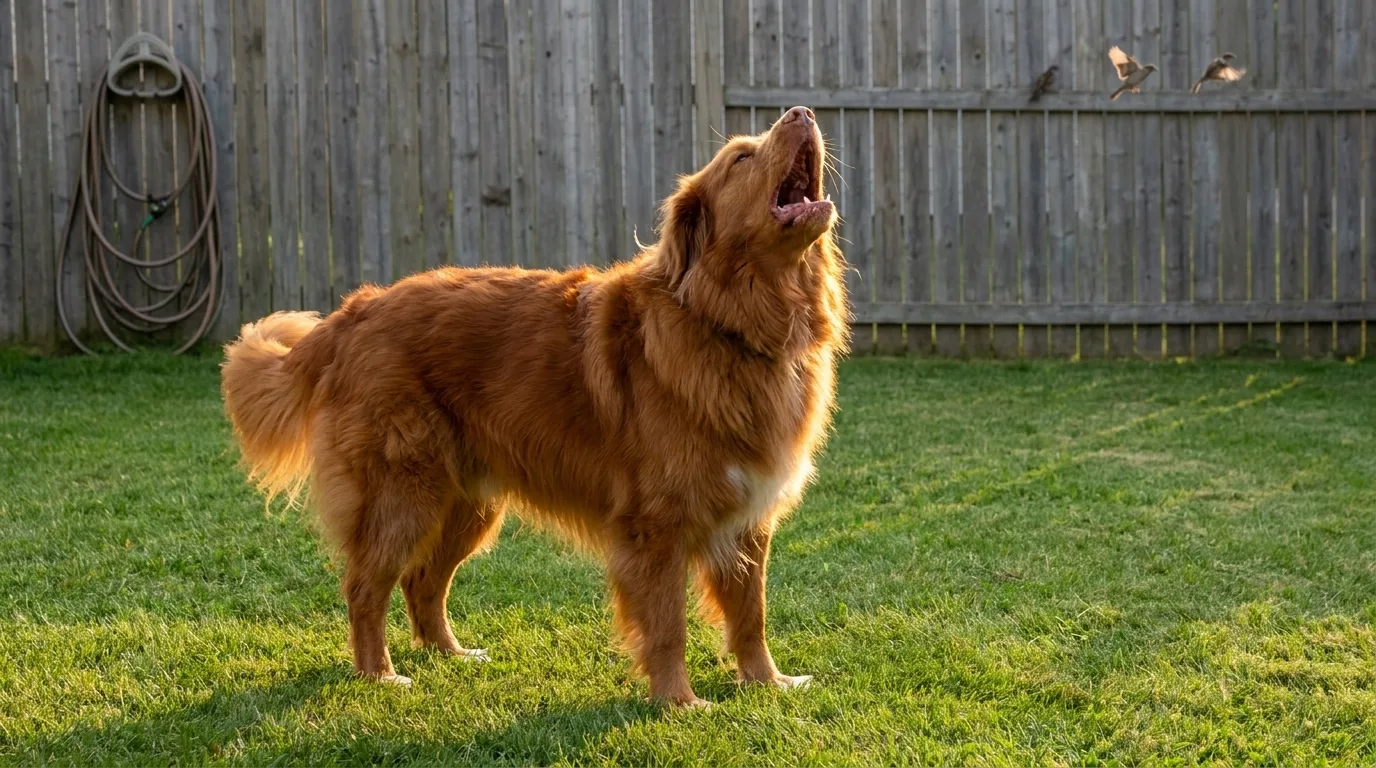
The delivery driver had one foot on the porch step when she went off in the yard. He did not drop the package. I want that noted for the record, because everything else about him stopped — mid-stride, one foot up, a man suddenly turned to statuary — while his eyes went looking for whatever was obviously, audibly dying nearby.
Nothing was dying. She had seen him, and he had a box, and boxes are wonderful, and this — the trill igniting into the full siren — was her way of saying so. He left the package on the step at a speed I would describe as professional. We wave now. He does not come up the walk.
A field guide to bystanders
After enough years, you can classify the reactions. There is the freeze, as performed by the delivery driver. There is the scan, beloved of hikers, who stop on the trail and search the treeline for injured wildlife while the actual source wags at their feet. There are children, who are delighted without exception and immediately attempt an imitation, which is how you learn the sound is also contagious. And there is my favourite: the distant nod from another dog person across the park — the slow, knowing nod of someone who has either owned a Toller or stood beside one, and requires no further briefing.
The conversations
The neighbour conversation happens early in every Toller owner’s career. Ours was over the fence, gently worded, the way people ask about things they are worried they should have reported: was the dog... alright? It gave me my first chance to deliver the sentence every one of us ends up saying, in the same slightly defensive tone: she’s not hurt, that’s her happy sound. Nobody believes it the first time. The evidence — a visibly ecstatic dog producing the sound of a disaster — does not help as much as you would think.
The vet waiting room is the advanced course. A Toller who has realized where she is and, worse, who is behind that door (she loves the vet; this is somehow louder than fearing the vet) can clear a lobby’s worth of composure in four seconds, while the owners of trembling, silent dogs look over in genuine alarm. Over the years my explanation has shortened the way all true things do: from a paragraph about breed history, to a sentence about excitement, to — now — three words, delivered with a shrug. She’s a Toller. It is remarkable how often that is enough.
The etiquette of the warning
You learn to brief the guests. You say the words she has a loud greeting, and your guests, who have met loud dogs, nod and are not remotely prepared, because no description survives contact with the real thing. I have tried them all — the trill, the siren, the kettle, the seabird with a grievance — and the result is the same: the sound arrives, the guest recalibrates their understanding of the word loud, and then, thirty seconds later, the second thing always happens. They laugh.
That is the part the warnings never capture: it is funny. Not at first — at first it is a fire drill — but the moment your brain accepts that this operatic emergency is a dog being pleased to see you, it becomes one of the funniest sounds in nature. The scream converts strangers in exactly two exposures. The first one alarms them. The second one they request.
From apology to introduction
Somewhere along the line, every Toller owner crosses the same divide: you stop apologizing for the sound and start introducing it. It is, after all, the most honest thing about the breed — the excitement arriving with the volume knob missing — and half the “what kind of dog is that?” conversations that end with someone researching the breed begin not with the red coat but with the noise. The scream, it turns out, is the breed’s best recruiter. It certainly recruited the delivery driver’s partner, who asked. Nobody screams about a boring dog.
So this is what surviving it actually looks like: not silence — you manage the arousal and keep the volume for special occasions — but a shift in what you hear. These days, when the trill starts winding up in the yard, I do not brace. I look up to see what wonderful thing is about to happen. It is usually a squirrel. To her, that has never once made it less worth announcing.
The practical version
What the scream is, every trigger, and how to actually reduce it — the complete guide.
The first time
The first time she screamed is the discovery story — what nobody tells you until you are standing in your own kitchen.