
Stories
Aging with grace: the golden years of a Toller
Watching the frost slowly gather around a once-vibrant red muzzle is a bittersweet journey — but the twilight years bring a profound, quiet companionship that somehow outshines the youthful chaos.
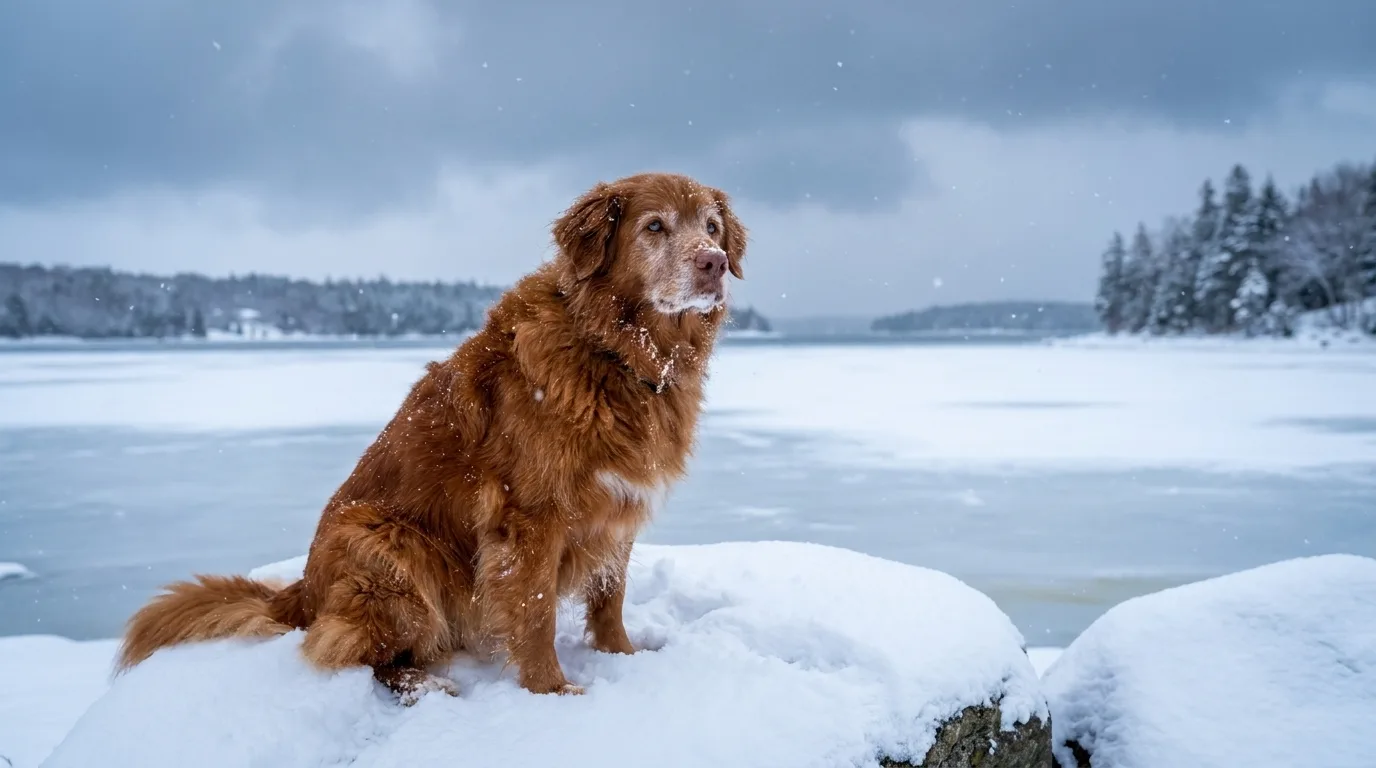
You never see it happen. That is the strange mercy of it. You live with a dog every single day, and daily is exactly the wrong interval for noticing anything. Then one evening you are scrolling back through old photos looking for something else entirely, and there she is, three years ago, and the muzzle in the photo is red.
You look up from the phone at the dog on the rug — the same dog, you would swear the same dog — and the muzzle looking back at you is dusted white, like frost on a fence rail, and you genuinely cannot say when that happened. It happened on your watch. You were there for all of it. And still it arrived like news.
The walks that shorten themselves
Nobody decides to shorten the walks. The walks shorten themselves. The dog who once treated a two-hour loop as a warm-up begins, with no announcement, to curate — still first to the door, still certain, but now the route has an editor. The far field gets cut. The hill stays, but slower, with a pause at the top that used to be for me.
Here is what nobody tells you about slowing down to an old dog’s pace: the pace has merits. For a decade this breed dragged me forward — faster, further, again — and I assumed the dragging was the point. It turns out the last third of the walk was always the good part, and we were sprinting through it. An old Toller stops to read a fence post like a letter. You stand there in the cold holding the leash, and gradually, embarrassingly late in life, you learn to read fence posts too.
What the engine leaves behind
I have written before about the engine that never powers down, and it is true, until the year it begins to idle. What surprised me is what remains when the drive quiets. The attention stays. All of it. The shadow at your heel does not retire; it just moves slower and chooses its posts with more care — from the kitchen doorway now, rather than underfoot, because the doorway has sightlines to everything and a rug.
The devotion, it turns out, was never powered by the engine. They were two separate systems all along. One winds down. The other does not seem to know how.
Watching, gently
Old dogs are stoics, and Tollers are proud ones. Nobody this cheerful will ever volunteer that something hurts. The signs are small and polite: the jump onto the bed that gets a running start it never used to need, the stairs taken with a new economy, dinner finished slowly and then, one day, not quite finished. None of it announces itself. All of it is information.
So the last job of loving an old dog is noticing on their behalf — knowing what normal looks like well enough to catch the day it shifts, and writing it down, because “a while ago” is no answer to a vet who asks “when did that start?” The watching is not morbid. It is the same attention they have spent a lifetime paying us, finally returned in kind.
The good days
Here is the secret nobody puts in the breed guides: the golden years are not a diminished version of the good years. They are a different country with its own weather. The chaos — the screaming, the counter-surfing, the ball delivered to your lap at six in the morning — resolves into something quieter and somehow larger: a companion who has known you longer than some of your friendships, asleep against your foot with a white muzzle, entirely certain of where they belong.
The frost on the muzzle is not the end of the story arriving early. It is the best chapter, and the only one written slowly enough to read properly. Snow gathers on the rocks by the bay; the red coat still glows against it. You put your hand on a warm old head, and you stand there together, reading fence posts, in no hurry at all.
The practical version
Knowing what “normal” looks like is half of senior care. The Senior Dog Health Journal is the undated record book built for exactly this — medications, mobility, comfort, and the good days worth remembering.
Common senior health signs
Toller health conditions covers what to watch for, at every age.
Keep reading
The Senior Dog Health Journal
An undated care planner for the golden years — handled gently.
The shadow with a red coat
The loyalty that outlasts the engine — lived in, not described.